Film studies and the film industry at large often fall into systemic biases regarding culture, race, and gender. Dominated by Western film theory and production, narratives from cultural, racial, or gender minorities are often treated as ‘pedestrian’, lacking value, or not being profitable enough.
 In photo: Professor Aaron Gerow (Yale University) at KAMC/MediAsia2025
In a panel titled ‘Expanding Film and Media History: Lessons from Japan’ moderated by Professor Timothy Pollock of Osaka Kyoiku University and Osaka Metropolitan University, Japan, leading scholars critiqued the Euro-American dominance of academic theory and proposed new methodologies for studying non-Western media. Covering topics around theoretical bias, and gender and sexuality misrepresentation, Professor Aaron Gerow of Yale University, United States; Professor Mitsuyo Wada-Marciano of Kyoto University, Japan; and Dr Yutaka Kubo of Kanazawa University, Japan, made several cases for more inclusivity and diversity within film studies and filmmaking.
Professor Gerow opened the panel by interrogating the very location of ‘theory’ within the discipline. He noted that standard film theory textbooks are overwhelmingly dominated by European and American thinkers, creating a ‘theory complex’ where Japanese cinema is treated merely as an object of study, a mere collection of texts to be analysed rather than a source of theoretical knowledge itself. Professor Gerow argued that this structure reproduces an imperialist dynamic, where the West provides the intellect and the East provides the raw material. He called for the ‘territorialisation’ of film theory, urging the academy to acknowledge the geopolitics of knowledge production. He highlighted the rich, yet largely ignored history of Japanese film theory dating back to the 1910s, pointing to pivotal figures like Gonda Yasunosuke, the first person in the world who wrote a 400-page theoretical treatise on film decades before Western film studies existed as a discipline. He noted that Japanese theorists in the 1940s were engaging in high-level discourse that often prefigured later Western concepts, such as Deleuzian film theory. Yet these contributions remain entirely absent from the global canon of theory. He urged scholars to excavate these texts not just to add Japan to existing theory, but to challenge the universalist pretensions of Western thought and recognise that theory itself is always culturally situated.
A Men’s World
“The Major Film Theories, Film Theories and Criticism, when you open these books, they are overwhelmingly European and American. They present this as film theory… supposedly to be universal. But really, is it?”
The panel transitioned to the gendered dynamics of film history, highlighting how the canon of Japanese cinema has been constructed as a ‘men’s world’. Through a close reading of the documentary Devotion: A Film about Ogawa Productions, Professor Wada-Marciano demonstrated how film history is often a closed loop of ‘men talking about men’. In the documentary, famous male directors like Ōshima Nagisa praise Ogawa Shinsuke, reinforcing a lineage of ‘masters’ that entirely excludes women. Professor Wada-Marciano presented a ‘revisionist’ history through the lens of female filmmakers, presenting statistics to illustrate the persistent structural inequality in the industry. She noted that in 2024, only 9.1% of Japanese films were directed by women, a figure that lags significantly behind neighbours like South Korea (29%) and Taiwan (30%). She argued that true expansion of the discipline requires not just adding women to the existing lists of directors, but fundamentally rethinking the criteria of value and the structure of the film industry, from education to distribution, that have systematically excluded them.
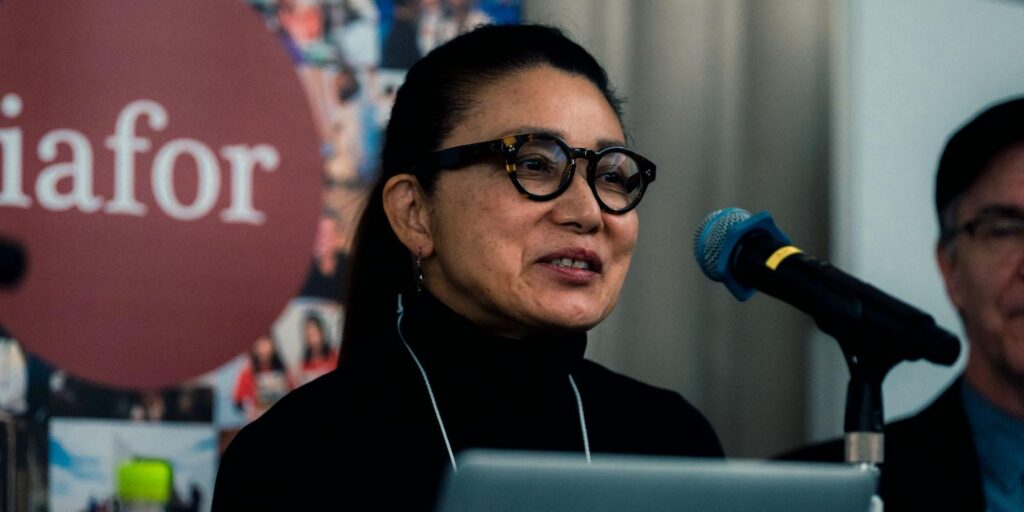 In photo: Professor Mitsuyo Wada-Marciano (Kyoto University) at KAMC/MediAsia2025
Risks when looking through a queer lens in Japan
Dr Yutaka Kubo concluded the panel with a discussion on queer cinema and the ‘heteronormative tension’ that still dominates Japanese academia. Dr Kubo described the personal and professional risks faced by scholars who choose to apply a queer lens to Japanese film, noting that the pressure to disclose one’s sexual identity can be a heavy burden for early-career researchers in a conservative academic environment. He detailed his own ‘curational interventions’ such as working with the NHK archives to locate and highlight erased queer memories in broadcasting history. Dr Kubo shared his struggle to convince a film distribution company to include the terms ‘aromantic’ and ‘asexual’ in the promotional pamphlets for a new film as an example of this. He described the industry’s hesitation to use terminologies associated with LGBTQ+, which they viewed as risky or niche. However, by framing the inclusion of these terms as socially relevant, he succeeded in altering the promotional strategy, demonstrating that academic intervention can have a tangible impact on public discourse and the visibility of marginalised identities.
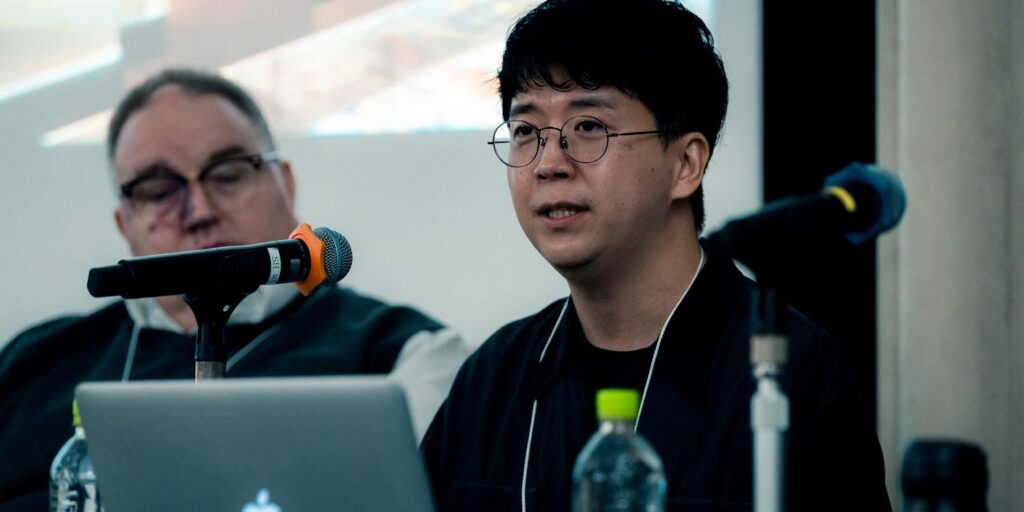
In photo: Dr Yutaka Kubo (Kanazawa University) at KAMC/MediAsia2025
“Film history is never complete because there’s always a presence of people whose voices and stories are silenced and overlooked in mainstream critical discourses.”
In a follow-up interview, Professor Pollock highlighted the importance of perseverance in expanding film history. He stated that the project of dismantling or decentring patriarchy within film history and theory will not be a finite task, but an ongoing, never-ending process subject to constant shifts. He noted that while progress is possible, there is always a risk of regression due to changing political landscapes, citing that even universities in certain countries may face punishment for teaching specific viewpoints. Despite the reality that this work may never be fully accomplished, it is important to be persistent. In doing so, it is not about adding new elements to the discipline, but rather revealing voices that were already present but previously unrecognised.
This article is an excerpt from the Conference Report and Intelligence Briefing: KAMC/MediAsia2025.
Banner image: Avel Chuklanov, Unsplash

You must be logged in to post a comment.