
Education experts discuss at ECE/ECAH/EGen2025 how STEM education must evolve for an AI-driven future, underscoring the importance of ethical adoption, critical thinking, creativity, sustainability, and human-centred learning.
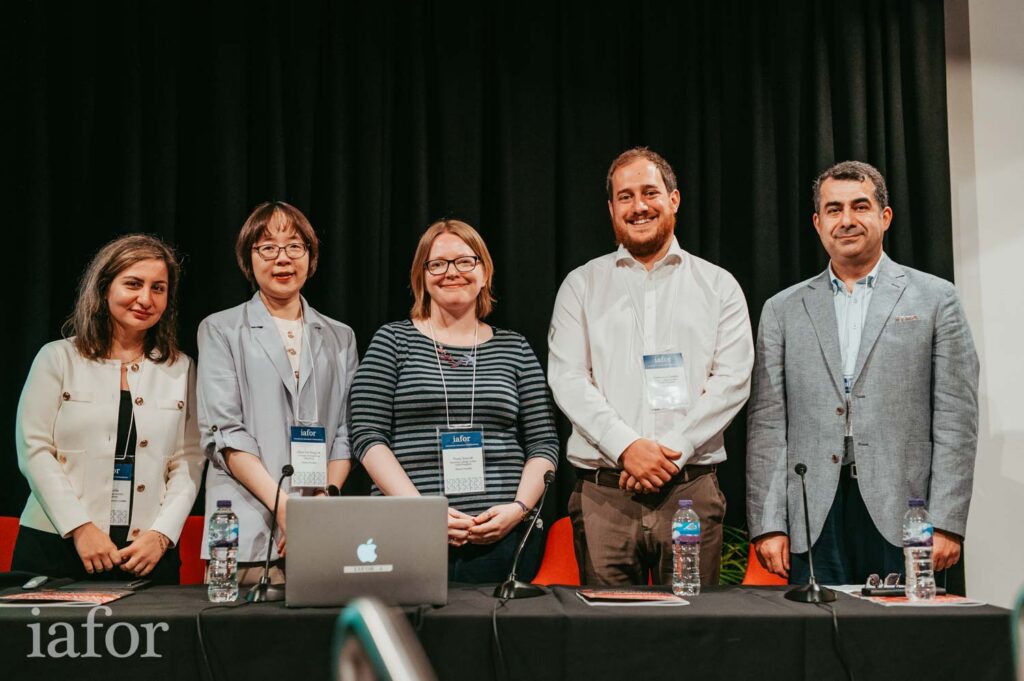
In photo (from left to right): Dr Rana Khalife of University College London (United Kingdom), Dr Lillian Yun Yun Luk of University of Hong Kong (Hong Kong), Dr Fiona Truscott of University College London (United Kingdom), Dr Francesco Ciriello of King’s College London (United Kingdom), and Professor Mo Zandi of University of Sheffield (United Kingdom) at ECE/ECAH/EGen2025
What exactly we should prepare students for in an AI-driven era was discussed during ECE/ECAH/EGen2025 in the panel titled ‘Technology and AI in Engineering/STEM Education: Preparing Engineering/STEM Graduates for Global Citizenship and Leadership’. Moderated by Dr Rana Khalife of University College London (UCL), four experts explored the transformative yet challenging role of AI in higher education, and what kind of skills are necessary for a future in which AI is involved in most of our decisions.

In photo: Professor Mo Zandi of the University of Sheffield (United Kingdom)
Professor Mo Zandi of the University of Sheffield opened by highlighting AI’s ubiquity: over 80% of businesses use it, with a surge in generative AI. He warned of ethical risks, including job displacement and biases. He stressed embedding AI ethics and safety from day one, shifting education from knowledge transfer to skills like critical thinking and creativity, as ‘AI will replace those who don’t know how to use it’.

In photo: Dr Francesco Ciriello of King’s College London (United Kingdom)
Dr Francesco Ciriello of King’s College London advocated ‘critical making’, where students embody intelligence in physical systems using AI across design processes (synthesis, geometry, manufacturing, control). He emphasised social learning dynamics, peer dialogue, and creating meaningful projects to develop global leadership skills, cautioning against isolating AI interactions.

In photo: Dr Fiona Truscott of University College London (United Kingdom)
Dr Fiona Truscott of University College London (UCL) shared practical integration in interdisciplinary projects, where AI aids writing (e.g., polishing for non-native speakers or dyslexic students) and visualisation (e.g., logos, ideas). Only 45% of students used generative AI, with varied applications; she promoted positive framing, declarations (distinct from citations), and awareness of sustainability issues (energy/water consumption), showcasing that AI reduces barriers in teamwork and interdisciplinarity by breaking language divides.

In photo: Dr Lillian Yun Yun Luk of the University of Hong Kong (Hong Kong)
Dr Lillian Yun Yung Luk of the University of Hong Kong (HKU) outlined HKU’s response: a compulsory AI Literacy Part 1 course for all first-years (starting September 2025), focusing on fundamentals, responsible use, and effective interaction, with a discipline-specific Part II planned. Student insights revealed anxieties regarding AI use in academia, such as fear of false AI-detection accusations or unfair peer advantages, underscoring the need for clear expectations and attitude-building toward learning.
The panel converged on ethical, transparent AI adoption: treating it as a supervised tool (‘intern’), prioritising critical thinking, sustainability, and equity (e.g., access via university platforms). Discussions urged proactive curriculum shifts, faculty training, and student involvement to prepare graduates for an AI-enhanced job market while preserving human-centric education.
Watch the full Panel Discussion in the video below.
Banner image: Tool., Inc, Unsplash

You must be logged in to post a comment.