
Media industries have commodified and altered audience focus, sacrificing spontaneity, diversity, and authentic human connection for profit-driven, algorithmic content. As Professor Padmakumar K argues, commercial radio’s shift toward visibility and homogenisation has eroded its unique intimacy, urging a return to creative, storyteller-driven “Radio Jockey (RJ) excellence” to restore its distinct power.
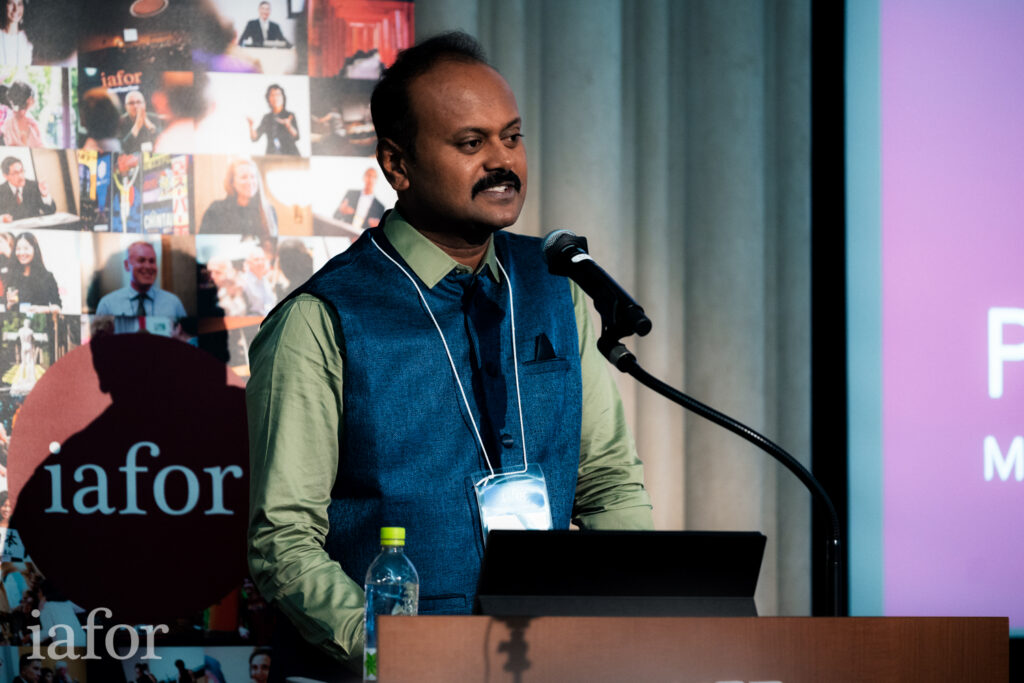
In photo: Professor Padmakumar K (Manipal Academy of Higher Education, India) at KAMC/MediAsia2025
Attention is recognised today as one of the most powerful currencies, and its commodification in the attention economy is manifested in all sectors of the media. It is a currency that can be easily manipulated: social media and radio broadcasting are swamped with advertisements and brand ambassadorships that encourage endless consumerism, and legacy media cave under heavy lobbying to broadcast only selected news, directing attention to more profitable narratives. Within the process of careful and engineered content curation, elements like spontaneity, agency, intimacy, curiosity, justice, empathy, or critical thinking—values once ascribed to humans—are lost. Communities and minorities also lose access to the means of information (re)production, and their voices are effectively marginalised.
Radio broadcasting is one area of entertainment in which these biases manifest. Professor Padmakumar K of the Manipal Academy of Higher Education, India, presented the state of Indian commercial FM radio with a keynote presentation titled ‘Reshaping the Soundscape: Engagement, Adaptations, Innovations and Hindrances in India’s Commercial FM Radio Channels.’ Professor K framed his analysis around the concept of the ‘engagement revolution’, arguing that radio, once a medium that held families captive in a shared listening experience, is now fighting for survival in an attention economy dominated by digital platforms. He described the historical essence of radio as the ‘theatre of the mind’, a medium defined by the invisibility of its presenters. In this traditional model, the Radio Jockey (RJ) was a mysterious figure known only by their voice and personality, which left listeners with an imaginative yet deeply personal connection to the RJ’s content. This ‘invisibility’ was not a deficit but a superpower, creating a sense of intimacy and spontaneity, where every song played felt like a surprise to the listener, and where listeners could actively engage with and affect the content being played.
In a desperate bid to compete with the visual dominance of modern media like Instagram and YouTube, radio stations are increasingly forcing their RJs to become visible brand ambassadors and social media influencers.
However, the radio industry is currently trapped in a ‘visibility paradox’. In a desperate bid to compete with the visual dominance of modern media like Instagram and YouTube, radio stations are increasingly forcing their RJs to become visible brand ambassadors and social media influencers. Professor K argued that this strategy is fundamentally counterproductive. Radio stations have broken the unique anonymity that sustained the listeners’ imagination by putting RJs in the spotlight, hosting mall events, maintaining active video profiles, and prioritising visual content over audio content. Furthermore, Professor K highlighted a content differentiation crisis plaguing the industry. He described how commercial pressures and a reliance on algorithmic tools have led to extreme homogenisation. Stations now subscribe to services that list every song played by competitors, leading to a cloning of formats where every station plays the same music in the same order to minimise the risk of losing listeners. It is fairly easy to identify the reproduction of formats and content worldwide when looking at shows like ‘the breakfast show’, ‘the late night show’, or ‘the drivetime show’.
This ‘algorithmic predictability’ has replaced the human spontaneity of the RJ, transforming the medium into a sterile, automated loop of pre-scheduled content and invisible advertisements disguised as jock talk. Professor K suggested that this commercial hijacking of programming space has alienated core audiences, with research showing that listeners find the relentless brand integration ‘annoying and irritating’. He concluded his presentation with a prescriptive framework for the future, urging the radio industry to stop mimicking and battling visual social media, and instead invest in ‘RJ excellence’: training presenters to be storytellers and music historians who can reclaim the unique auditory intimacy that originally defined the medium.
Watch the full keynote speech by Professor Padmakumar K in the video below.
Banner image: Koen Sweers, Unsplash

You must be logged in to post a comment.